Is There a Chance That a Cae Goat Wont Pass Cae to Baby
Three diseases all goats owners should exist aware of, test for, and work to prevent
Written in 3/5/2005
Caprine arthritis encephalitis (CAE), Caseous Lymphadenitis (CL), and Paratuberculosis (Johne's disease) are diseases that cause weight loss, decreased production and various clinical symptoms in your herd. They tin effect in a significant economic loss to goat producers also as emotional stress to the pet owner. Furthermore, the run a risk of human infections with CL and Johne's is a pregnant factor in today'southward environs of homesteaders who do non pasteurize their goats milk.
All three of these diseases tin progress very slowly with few or no symptoms until the animal is suddenly very ill. In that location is no constructive treatment for whatever of these diseases. All three of these diseases are spread through the milk from affected does to their kids or to whatsoever other goats that may come in contact with the milk. Additionally, the diseases can exist spread from developed to adult past straight contact.
Cae
Caprine arthritis encephalitis is a viral disease. The organism is shed in the body fluids of infected animals such as milk, colostrums, nascency fluids, nasal droplets, etc. The virus lives in the goat'southward white blood cells, then annihilation that has white blood cells can spread the disease. (Ane of the near common methods that I run across is the reuse of needles. Injecting an infected goat with a drug and so reusing the needle on another goat tin spread this illness!) This virus does not alive very long outside of the surroundings then if you spill infected non-pasteurized milk on the ground, keep the other goats away from it for a while and then don't worry about it. The number of animals with this disease that show symptoms is usually low, about 35%, but this number will increase with stress and poor management.
CAE can cause an arthritis that affects multiple joints, pneumonia, mastitis and occasionally a paralysis of 2-six calendar month one-time kids. The typical CAE mastitis affects both sides and the mammary glands become difficult but not lumpy like typical bacterial mastitis.
At 8 months of age this does knees looked "normal", and she won GCH and Best junior doe in show. 2 weeks later they started rapidly enlarging, and were painful. The practiced genu is double normal size and the bad knee triple normal size. The knees are painful to the affect, and warm to the impact. She is now 10 months old and beginning to loose weight despite non existence anemic. This does mother tested negative for CAE for ii years in a row earlier testing positive this twelvemonth.

Johne's
Paratuberculosis is caused by a mycobacterium species. This organism tin can survive for over a year in manure contaminated environments. Kids can get the disease from nursing dams with contaminated manure on their udders, or they tin become information technology from an infected dam through the milk or even in the uterus. Adult goats can go it from contact with infected carrion or body fluids such as milk or birth fluids. The time between initial infection and symptoms can be extremely long just the goats can shed the organism in their stool very presently after being infected. Only a few animals will always testify signs of the disease, but all infected animals volition shed the organism. Many animals will appear very salubrious just test positive and shed the disease. Unfortunately, the exam is not 100% sensitive only most 50-88% of infected animals will test positive. Some animals will test negative, yet yet be shedding the organism.
Clinical signs generally don't occur until the brute is ii-four years of age. The animals have progressive weight loss leading to emaciation even though they initially appear to eat well. The afflicted goats are weak, bloodless, have rough pilus coats, and poor peel condition. Although cattle with Johne's develop diarrhea, we don't see that in our goats. In the final stages of the disease earlier death we may run into anorexia, and clumping of stool. Usually goats die inside half-dozen-12 weeks of first showing signs.
Caseous Lymphadenitis (CL)

This CLA abscess in a parotid lymph node is almost to rupturing. photograph courtesy of Dr. Mary C. Smith, DVM Associate Professor New York State College of Veterinary Medicine
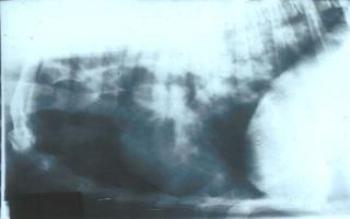
Chest radiograph showing a pattern that looks similar CAE or CLA pneumonia Photo Courtesy of Dr. Mary C. Smith, DVM Associate Professor New York State Higher of Veterinarian Medicine
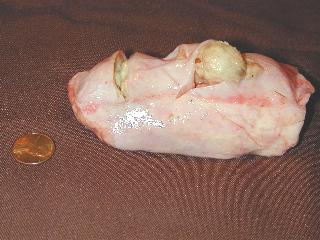
Lung abscesses showing the typical yellow/green colored thick pus
Caseous Lymphadenitis is a contagious bacteria like affliction. It occurs in both sheep and goats. The organism enters goats through cuts in the pare or mucous membranes such as the oral cavity. It causes abscesses of the lymph nodes that announced to have a thick yellowish to light-green toothpaste similar material in them. These abscesses can occur in the lymph nodes simply under the peel or they tin occur internally in the organs such as the liver, udder, or lungs. Once the goat becomes infected they keep to have repeated abscesses for life. If you lot sell the goat for meat, there will exist a downgrading of the carcass if at that place are abscesses. Abscess that rupture will contaminate the environment. The organisms are very difficult to kill and will exist able to infect goats for years. Internal abscesses can cause chronic weight loss, practise intolerance, difficult breathing, chronic cough or sudden death.
Once the surroundings has been contaminated, everything that has come in contact with the fabric should be burned. Using Clorox bleach solutions on debate rail etc, may decrease the chance of contamination. Vaccination is available, the vaccine will cause severe abscesses to class if information technology is given to goats that are already infected with the organism. The vaccine volition non forestall the disease in uninfected animals just it volition decrease the number and size of the abscesses every bit well as the overall numbers of animals that abscess.
Ways to prevent the spread of these disease
1) All kids must be taken off of their moms at nascency and fed heat treated colostrums (heated between 133 and 138 degrees F (56-59 degrees C) for 1 hr in water bath; and so aliquot and freeze. Do not exceed recommended temperature. (Temperatures above 140 degrees F denature antibodies.)
2) After initial colostrum give but pasteurized milk.
3) The kids must be kept in an environment that has not ever had infected animals in it (CL and Johne'south)and they should never exist introduced to the infected herd. (with all 3 diseases).
4) Buy new goats from herds that have tested and are negative for these diseases. Exam and quarantine these newcomers. If this is non done, in one case in the herd, these diseases are extremely hard to get rid of.
v) Offset a test and choose programme. Remember that no exam will detect 100% of the infected but non symptomatic animals.
Share This Story, Choose Your Platform!


Source: https://salecreek.vet/three-diseases-all-goats-owners-should-be-aware-of-test-for-and-work-to-prevent/
0 Response to "Is There a Chance That a Cae Goat Wont Pass Cae to Baby"
Post a Comment